This Week in AI: Anthropic's Secret Model, Meta's Comeback, and ChatGPT Gets Pricier

A lot happened in AI this week. Here's what caught my attention.
Anthropic built something they're too scared to release
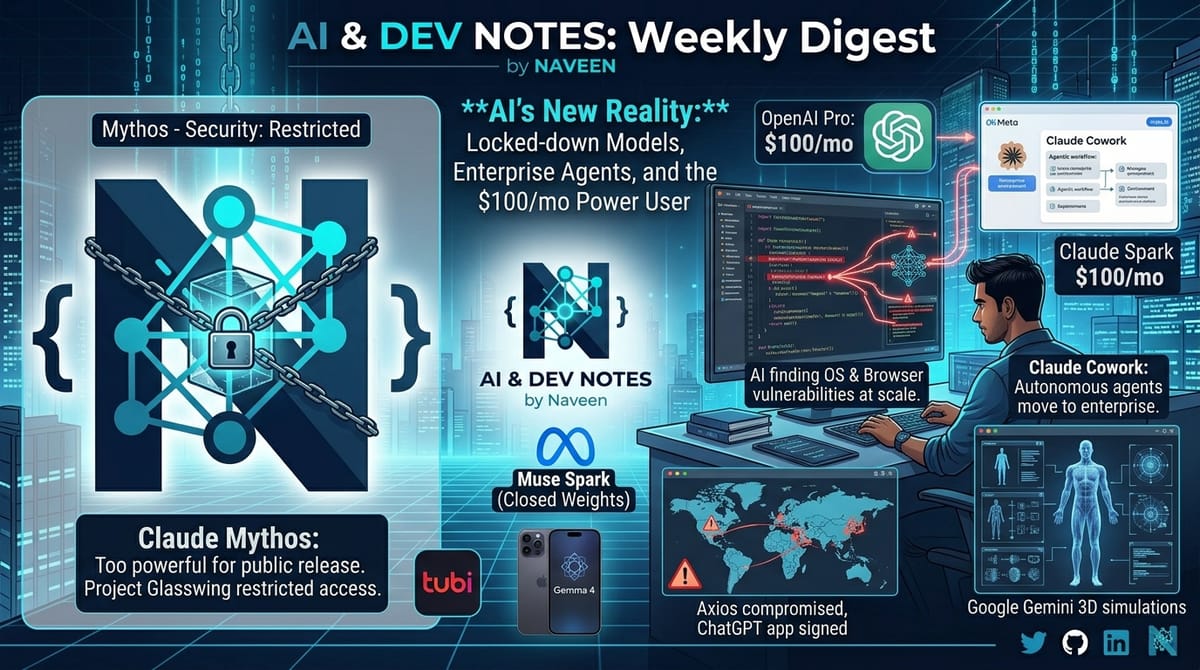
The most interesting story of the week: Anthropic trained a new model called Claude Mythos and decided not to release it publicly. Instead, they're letting only a select group of security researchers access it under something called Project Glasswing.
Why? Mythos reportedly discovered security flaws "in every major operating system and web browser." Quietly terrifying. Simon Willison's take was that restricting it sounds necessary and honestly, I agree. A model that can autonomously find zero-days at scale isn't ready for public access. We're at a weird point where the most capable models are being kept locked away not because
they're bad, but because they're too good at the wrong things.
On the business side, Anthropic also announced their run-rate revenue has hit $30 billion and signed a deal with Google and Broadcom for multiple gigawatts of TPU compute starting 2027. The magnitude of this situation is difficult to comprehend.
Meta is back with Muse Spark
Meta dropped their first new model since Llama 4 a year ago this one's called Muse Spark. Unlike Llama, it's not open weights it's hosted on meta.ai and requires a Facebook or Instagram login to try. A bit ironic given Meta's open source reputation.
The Meta AI app apparently jumped to #5 on the App Store after the launch. I haven't tried it yet but curious whether it actually competes with Claude and ChatGPT in day-to-day use.
Claude Cowork is going enterprise
Anthropic's agentic workspace tool Claude Cowork basically an AI that can work autonomously inside your company is now getting proper IT admin tools for company-wide deployments. It also added the ability to turn Zoom meeting transcripts into action items automatically.
The Verge headline was "Claude Cowork is ready to take over your company." Not wrong. Agentic AI moving from demos to actual enterprise deployments is the real story of 2026.
OpenAI raised their prices (a lot)
ChatGPT launched a new $100/month Pro subscription this week. That's on top of the existing Plus tier. It gets you access to Codex their advanced coding model and presumably the bestmodels for heavy use.
Sierra's Bret Taylor said this week "the era of clicking buttons is over" meaning we're moving from software interfaces to just telling AI what to do. At 100/month, OpenAI seems to agree that real power users will pay for it.
The Axios supply chain attack hit OpenAI too
This one's a bit scary. The popular npm library Axios was compromised on March 31 attackers socially engineered a maintainer and inserted malware. Turns out OpenAI's macOS app signing process used Axios, which means the ChatGPT desktop app's code signing certificates were exposed.
OpenAI responded by issuing new certificates and an update. Nothing catastrophic, but it's a reminder that the whole open source dependency chain is a massive attack surface. The Axios postmortem is worth reading if you're into security.
AI is finding real vulnerabilities in open source fast
Related to the above: the Linux kernel maintainer and the cURL lead developer both noted this week that AI-generated security reports have gone from "obvious slop" to "real, high-quality reports" in the last month or so. The Linux kernel team went from 2-3 legitimate AI reports per week to 5-10 per day.
Claude Mythos apparently found issues in every major OS and browser. AI is becoming a legitimate security research tool, which cuts both ways.
Quick hits
- Google Gemini can now answer questions with 3D models and simulations genuinely cool for
learning technical concepts visually - Google AI Edge Gallery is an official iPhone app for running Gemma 4 locally on device a 2.5GB download that actually runs well. First time a major lab released an official on-device
demo app - ChatGPT voice mode uses a much older model than the text interface GPT-4o era, knowledge
cutoff April 2024. The gap between "best model" and "most accessible interface" is quietly huge - Tubi became the first streaming service to launch a native ChatGPT app you can describe your mood and get recommendations directly in ChatGPT
That's the week. A lot of it points to the same thing: we're past the "demos" phase and into
infrastructure, enterprise deployment, and genuine capability milestones — some of which are
alarming enough to keep locked in a lab.
See you next week.
